


Secure AI Adoption for Regulated Industries: Defense, Law, Accounting & Construction
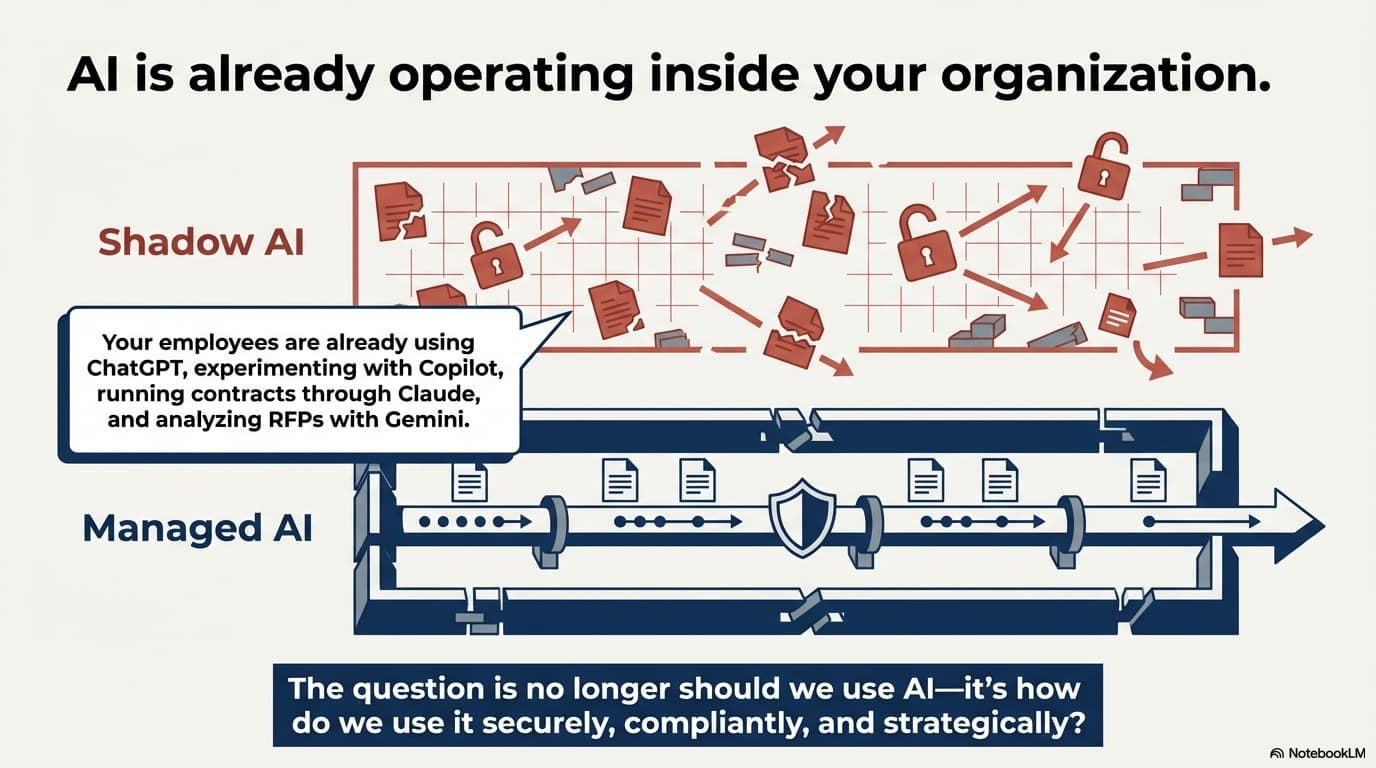
AI is already inside your organization. Your employees are using ChatGPT, experimenting with Copilot, running contract language through Claude, and analyzing RFPs with Gemini. The real question is no longer should we use AI — it’s how do we use it securely, compliantly, and strategically?
This guide breaks down the top AI tools businesses are using today, how regulated industries are applying them, and what guardrails you must have in place to avoid compliance and security risk.
Practical guidance on tools, use cases, and minimum security baselines for regulated environments.
Call HD Tech: 877-540-1684
Orange County-based • Serving nationwide
The Big 5 AI Tools Businesses Are Using Today
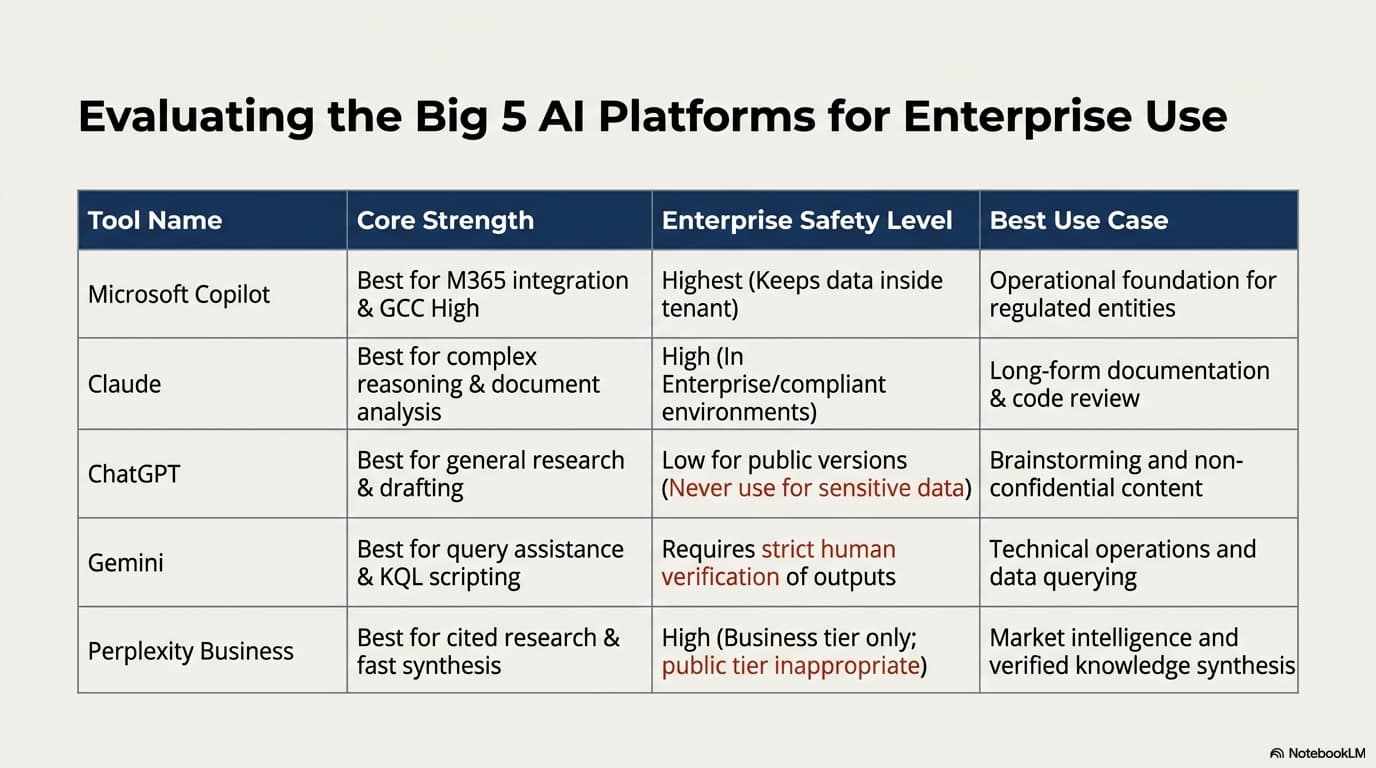
Across industries, five major AI platforms dominate business usage. Each has distinct strengths, but they are not interchangeable — especially in regulated environments.
Microsoft Copilot
Copilot is best for Microsoft 365 organizations — a productivity layer across Outlook, Teams, Word, Excel, and SharePoint. It keeps data inside your tenant and supports enterprise controls.
Claude
Claude excels at complex reasoning, long-form document analysis, and code review — ideal for documentation-heavy teams.
ChatGPT
Great for drafting, brainstorming, and research. Public versions should never be used for sensitive data — enterprise usage must be governed by policy.
Gemini
Strong for query assistance and scripting. Outputs require human verification — AI can sound right and still be wrong.
Perplexity Business
Valuable for research with citations, market intelligence, and fast synthesis. Business-tier access is essential for professional use.
Bottom line
In regulated industries, start with a secure operational foundation (often Copilot in Microsoft 365), then add other tools where appropriate — with governance.
AI in Defense Contracting: Security First, Always
Defense contractors operate under demanding cybersecurity frameworks. If you touch CUI or export-controlled data, your AI posture must align with your compliance obligations.
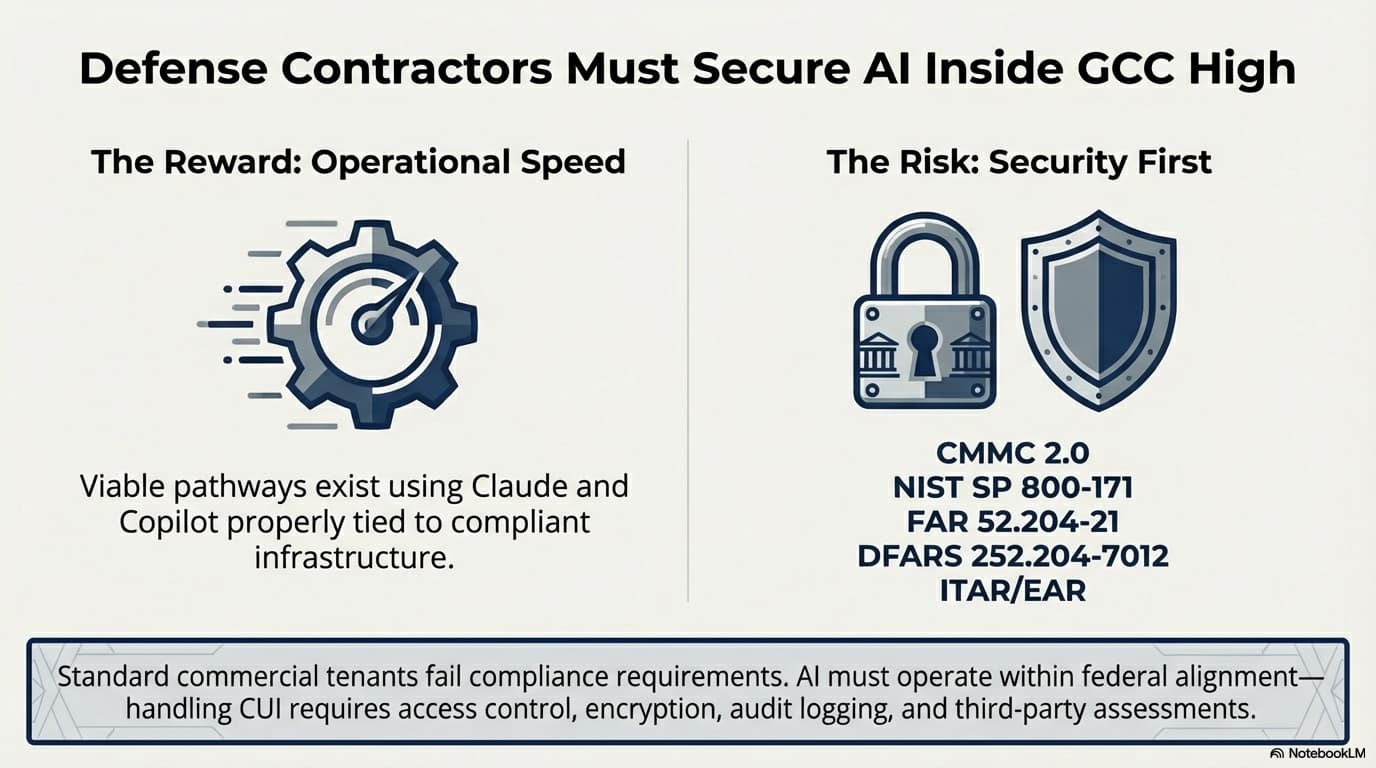
What AI tools are viable for defense contractors?
In DoD environments, Claude and Copilot tied to a GCC High tenant represent the viable path. AI must operate within environments aligned to required controls — this is more than enabling a feature.
Secure AI in GCC High
When configured properly, AI operates inside compliant infrastructure. Data does not enter the public domain, and logging/access controls support federal requirements. Misalignment can jeopardize contracts.
AI in Law Firms: Confidentiality Is Non-Negotiable
Law firms are using AI for contract comparison, drafting, motion prep, and billing analysis — but uncontrolled usage is a major liability.
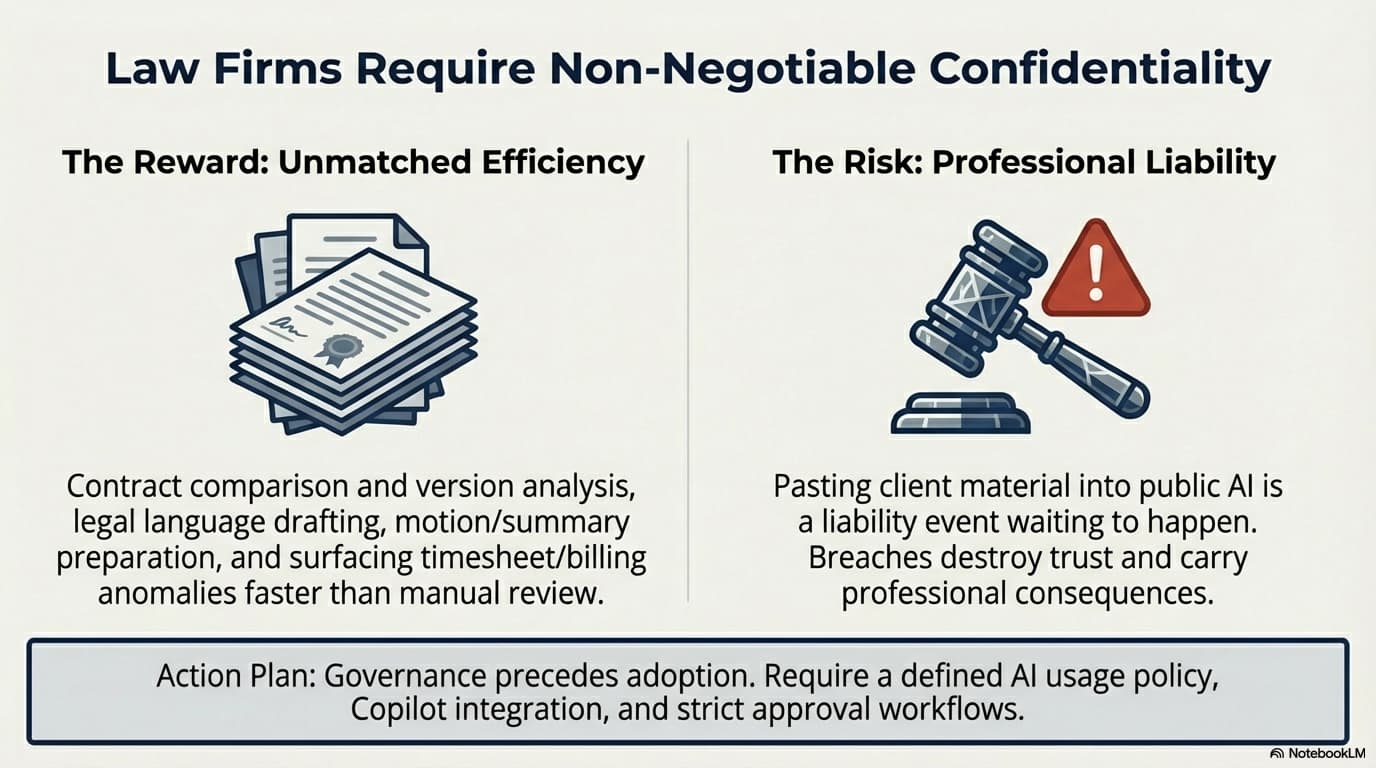
The risk: uncontrolled usage
If attorneys paste confidential client material into public AI tools, that’s a breach waiting to happen. Confidentiality failures can carry professional consequences and destroy trust.
What law firms must have in place
At minimum: an AI usage policy defining allowed/prohibited data, secured enterprise tools (ex: Copilot), approval workflows, and staff training. Governance must precede adoption.
AI in Accounting & CPA Firms: Precision Plus Privacy
Accounting teams use AI to analyze large datasets and summarize updates — but financial data, PII, and tax records must stay protected.
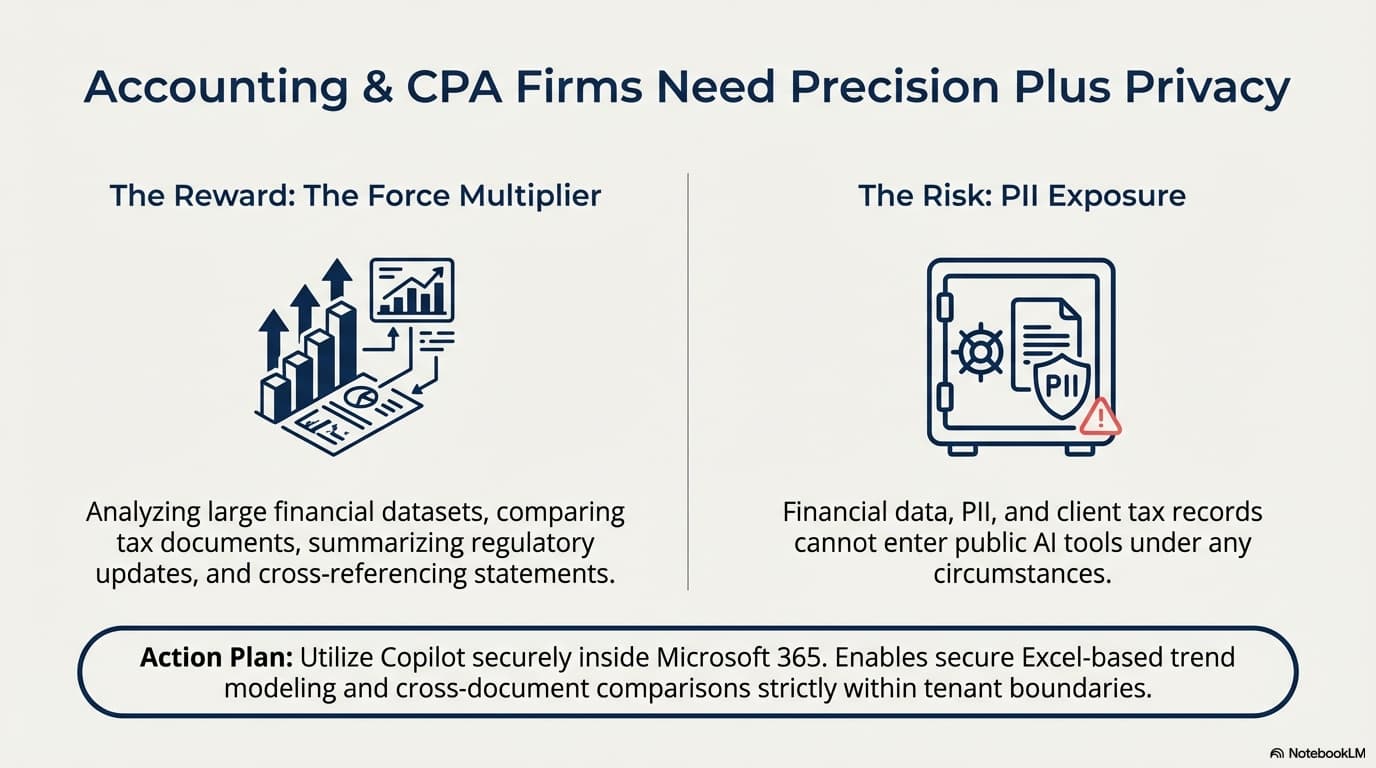
Where AI helps most
Compare tax documents, summarize regulatory updates, audit time inputs, and cross-reference statements — faster and more consistently.
What must never happen
Client financials, PII, and tax records must not enter public AI tools. Keep analysis inside secured, policy-controlled platforms.
AI in Construction: Operational Intelligence at Scale
Construction teams use AI for RFP/proposal acceleration and operational insights from ERP and ticket data — with big time savings.
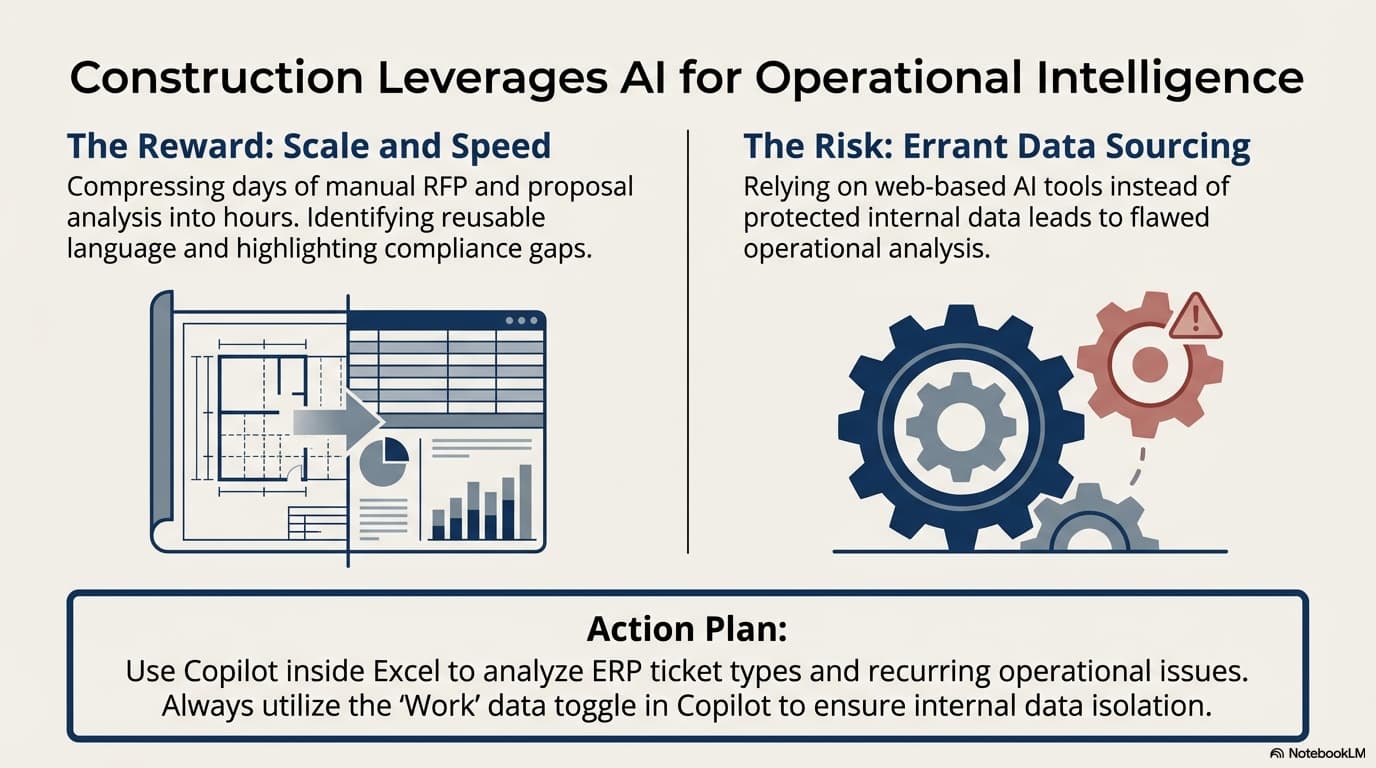
RFP and proposal analysis
Compare past proposals against new RFPs, reuse language, shorten timelines, and highlight compliance gaps — compressing days into hours.
ERP extraction and trend analysis
In Excel with Copilot, identify recurring ticket types, detect inefficiencies, and surface patterns without manual filtering. Use tenant/work data controls — not web-based AI.
Why We Recommend Copilot as the Operational Foundation
Claude and Perplexity are powerful for reasoning and research, but Copilot provides tenant-level protection, deep Microsoft integration, identity-based access control, audit logging, and admin guardrails.
Tenant-level data protection
Keep work data within your Microsoft environment with policy controls and governance.
Identity + access control
Leverage existing identity, permissions, and role-based access to limit exposure.
Audit + admin guardrails
Support compliance posture with logging, monitoring, and administrative configuration.
The Security Reality: Your Employees Are Already Using AI
Whether approved or not, AI is already in use. Without policy and controls, data will leak, compliance will drift, and risk will grow.
Policy
Define what’s allowed and prohibited — and make it enforceable and easy to follow.
Controls
Use technical controls inside Microsoft 365: permissions, DLP, retention, and governance settings.
Monitoring
Logging + alerting so your team can detect misuse, respond quickly, and prove compliance.
How We Use AI as an MSSP
We don’t just recommend AI — we use it every day, always layered with human oversight.
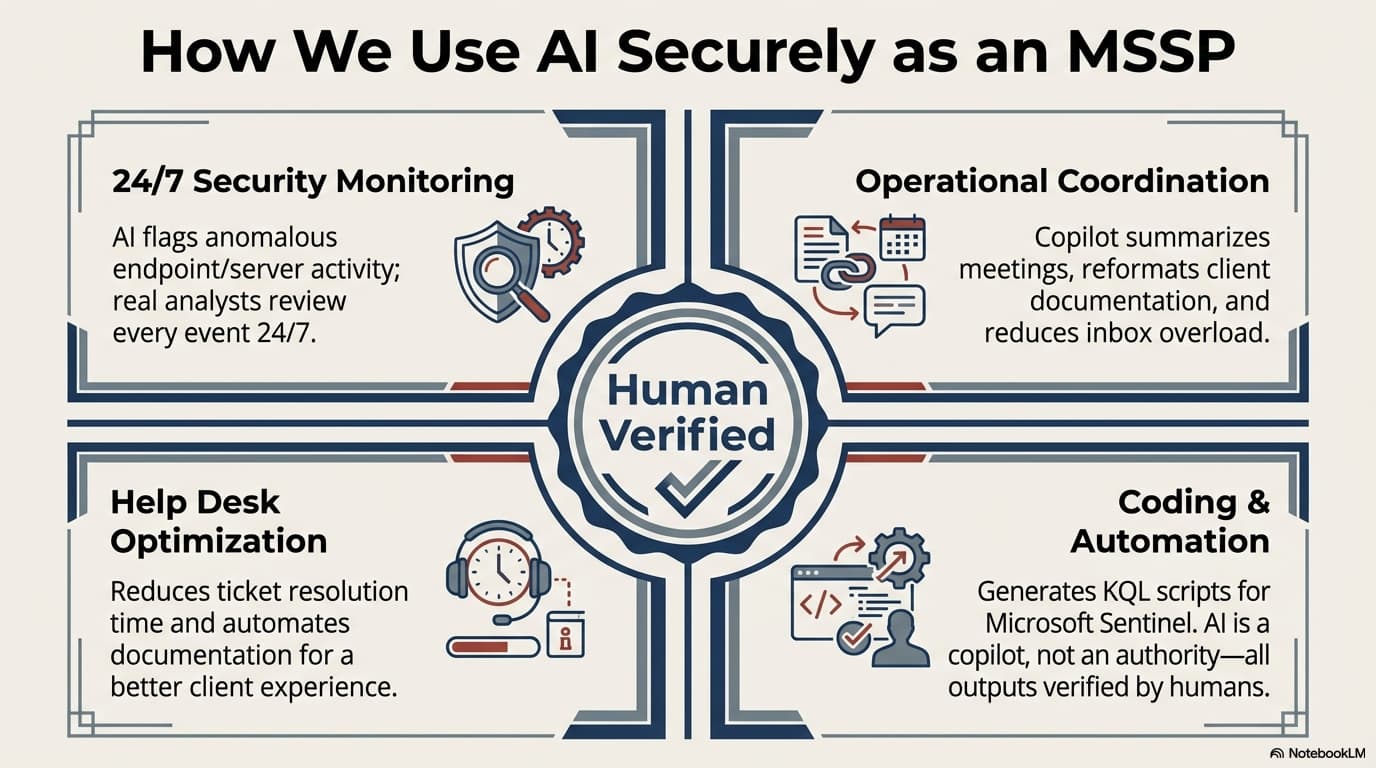
24/7 AI-assisted security monitoring
AI flags anomalies across endpoints and servers — every event is reviewed by real security professionals, 24/7.
Copilot for operational coordination
Summaries, documentation formatting, reporting, and communication organization — reducing admin overhead.
AI for help desk optimization
Reduce time to resolve tickets, improve documentation, and lower technician workload by automating repetitive work.
AI for coding and automation
Accelerate scripting (including KQL for Sentinel) and automation — outputs are verified by humans.
The Right Way to Adopt AI in Regulated Industries
AI adoption should follow a structured sequence: assess requirements, deploy enterprise AI in a secured environment, configure tenant controls, develop policy, train employees, monitor activity, and continuously review risk posture.
1) Assess requirements
Map compliance obligations and data types before selecting tools.
2) Deploy securely
Roll out enterprise AI inside controlled environments — not public tools.
3) Configure controls
Identity, permissions, DLP, retention, logging, and admin settings.
4) Write policy
Define acceptable use, prohibited data, approvals, and enforcement.
5) Train users
Teach safe prompts, verification habits, and what not to upload.
6) Monitor & improve
Review logs, tune rules, and update governance continuously.
FAQ
Fast answers to the most common questions we hear from regulated organizations adopting AI.
Is it safe to use AI in a defense contracting environment?
Yes — but only when deployed inside compliant environments such as GCC High and aligned with your required controls. Public AI tools are not appropriate for CUI or export-controlled data.
Can law firms use AI for contract review?
Absolutely. AI is excellent at comparing versions and identifying discrepancies — but firms must use enterprise tools and implement an AI usage policy to protect confidential information.
What is the biggest AI risk for businesses?
Uncontrolled usage. Employees pasting sensitive data into public AI platforms creates significant compliance and legal exposure. Governance must come first.
Why is Copilot safer than public AI tools?
Copilot operates inside your Microsoft tenant. Data stays within your environment and supports identity management, audit logging, and compliance configuration.
Does AI replace cybersecurity analysts?
No. AI enhances monitoring and productivity, but human oversight remains critical — especially in threat detection and compliance-sensitive industries.
Make AI your competitive advantage — not your liability.
HD Tech helps defense contractors, law firms, CPA firms, and construction companies implement AI securely, compliantly, and strategically — backed by real humans around the clock.
What we deliver
24/7 monitoring • rapid incident response • enterprise-grade cybersecurity • secure Microsoft 365 & Copilot deployments • compliance alignment • AI governance policy development.